Makhana Processing
Makhana Cleaning Machine
Industrial cleaning equipment for cleaning makhana and removing foreign matter.
- Type
- Cleaning
- Makhana
We use first-party data to understand how visitors use this site, and may use optional analytics tools if you allow it. See our Privacy Policy.
From Raw Makhana Seeds to Popped, Flavoured and Packaged Products
Plan your makhana processing facility around the product you want to make, the capacity you require, and the space available at your site. MechRoutes helps you explore and configure the machinery required for primary makhana processing, value-added snack production, or an integrated facility.
A complete plant can be configured according to your starting material and target product.
For customers who want to process raw makhana seeds through cleaning, drying where required, grading, roasting, popping, and final grading.
Explore Primary ProcessingFor customers who purchase already-popped makhana and want to produce roasted, flavoured, weighed, and packaged snack products.
Explore Snack ProcessingFor customers who want primary processing and downstream snack manufacturing planned together.
Discuss an Integrated PlantThe exact sequence depends on the processing technology and product you choose. Mechanized systems often integrate roasting and popping into one continuous machine rather than two separate steps.
Raw makhana seeds → popped makhana.
Raw Seed Receiving
Raw makhana seeds are received and inspected.
Cleaning
Foreign material is removed from the raw seed before grading.
View Makhana Cleaning Machine →Drying, If RequiredIf required
Raw seed is dried where the selected process requires it.
Primary Roasting
Pre-heating/primary roasting conditions the seed for popping.
View Makhana Roasting Machine →Tempering
The seed is tempered/conditioned between roasting stages.
Final Roasting
Final roasting immediately ahead of popping. On mechanized lines, this stage and popping are often integrated into one continuous roaster rather than two separate machines.
View Continuous Makhana Roaster →Popping
The seed pops into raw makhana under heat.
Cleaning and Popped-Makhana Grading
Popped makhana is cleaned, sorted and graded.
View Makhana Sorting Machine →Storage or Transfer to Snack Processing
Graded popped makhana is stored or moved directly into secondary processing.
View Makhana Conveyor →The equipment list depends on whether you are processing raw seeds, manufacturing ready-to-eat snacks, or integrating both. The final bill of equipment is prepared after requirement analysis.
Machinery for converting raw makhana seeds into popped makhana.
Makhana Processing
Industrial cleaning equipment for cleaning makhana and removing foreign matter.
Equipment selection depends on more than the advertised capacity of one machine. The profiles below are planning categories, not guaranteed throughput figures.
For businesses starting commercial production or setting up a smaller facility.
For businesses that need a coordinated processing line and room to expand.
For businesses planning larger, integrated production operations.
A plant layout accounts for raw-material movement, equipment placement, processing sequence, personnel movement, utilities, maintenance access, hygiene, and finished-goods storage.
Flavour names below describe possible product applications, not a guarantee that every flavouring process is included in a base plant.
Installation and commissioning are subject to the agreed quotation and service scope, not automatically included in every order.
Establish the raw material, desired finished product, expected output, and project objectives.
Select primary processing, secondary snack processing, or an integrated workflow.
Identify compatible machines and the required supporting systems.
Review the facility dimensions, material movement, utilities, and machine access.
Prepare the proposed equipment list, specifications, exclusions, commercial quotation, and installation scope where applicable.
Proceed according to the agreed supply, installation, testing, commissioning, and support responsibilities.
ICAR-CIPHET, Makhana Primary Roasting Machine documents a documented raw-seed throughput of 80–100 kg/hour under its described equipment configuration.
This is ICAR-CIPHET's figure for that specific research machine, not a guaranteed capacity of any MechRoutes product or complete plant.
ICAR-CIPHET, Popped Makhana Grading Machine documents a documented capacity of 150 kg/hour.
This is ICAR-CIPHET's figure for that specific research machine, not a guaranteed capacity of any MechRoutes product or complete plant.
Plant capacity, utility requirements, dimensions, and equipment specifications are finalized according to the selected configuration and approved quotation.
Tell us what you want to process, your expected production output, and the space available at your facility. MechRoutes can help you identify the relevant machinery categories and prepare a plant configuration for discussion.
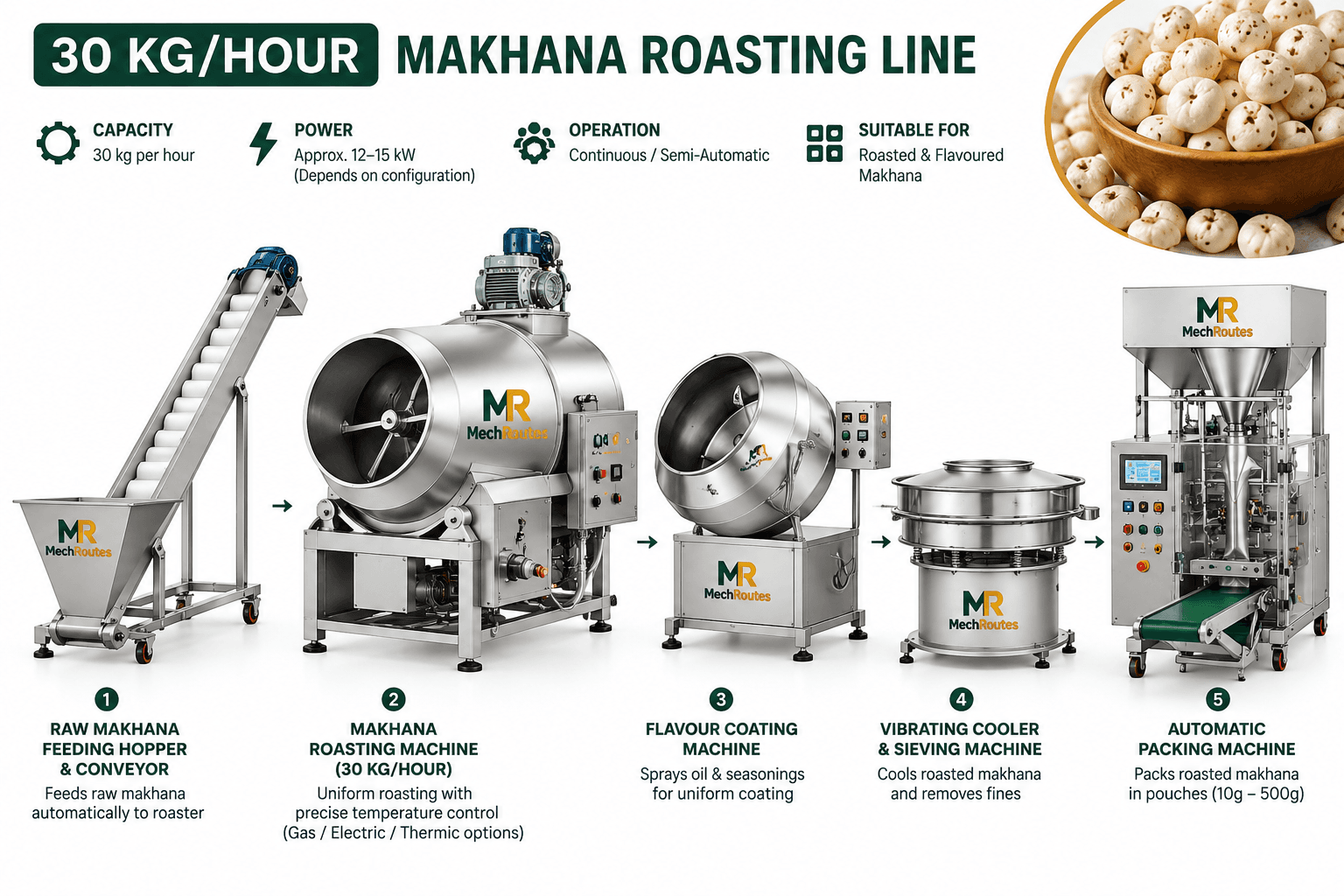
Talk to the MechRoutes TeamIllustrative process sequence, not a photograph of an installed line. The stages included depend on whether you configure primary processing, secondary processing, or both.
Makhana Processing
Controlled roasting equipment for makhana (fox nuts), available in capacities from 30 to 500 kg/hr.
Makhana Processing
Industrial roasting equipment for controlled roasting of makhana.
Makhana Processing
Industrial sorting equipment for sorting makhana and separating rejects.
Also part of this group: Raw material receiving and handling · Drying equipment, where required · Tempering and conditioning arrangements · Intermediate storage and collection systems
Machinery for turning popped makhana into roasted, flavoured, packaged snacks.
Makhana Processing
Industrial sorting equipment for sorting makhana and separating rejects.
Makhana Processing
Controlled roasting equipment for makhana (fox nuts), available in capacities from 30 to 500 kg/hr.
Makhana Processing
Industrial coating and seasoning equipment for coating and seasoning makhana.
Makhana Processing
Industrial coating and seasoning equipment for coating and seasoning makhana.
Makhana Processing
Industrial weighing equipment for weighing and dosing makhana.
Also part of this group: Sealing and batch-coding equipment · Metal detection or other inspection equipment, where required by the specification
Planning items that support the primary and secondary equipment above.
Electrical distribution and machine controls · Suitable conveyors and transfers · Compressed-air supply, if required by selected machines · Ventilation and heat management · Hygienic product-contact surfaces · Access and maintenance clearances · Raw-material and finished-goods storage · Cleaning and sanitation provisions
Final equipment placement and dimensions depend on verified machine drawings, the building layout, utilities, safety requirements, and the approved project scope.
Makhana flour is a separate downstream application requiring its own milling and sieving equipment, not part of the roasting/seasoning line above.
A coordinated set of machinery, configured together, for converting raw makhana seeds into popped makhana, for turning popped makhana into packaged snacks, or both.
Raw-seed (primary) processing starts with unpopped seeds and produces popped makhana. Snack (secondary) processing starts with already-popped makhana and produces a roasted, flavoured, packaged product.
Yes. A secondary-processing line can be configured to take already-popped makhana straight into roasting, seasoning, weighing and packing, without any primary-processing equipment.
Typically cleaning, grading, roasting/popping, cooling and grading equipment, plus the conveying and storage needed to move material between stages. The exact list depends on your process and is confirmed during configuration.
On many mechanized lines, final roasting and popping happen in the same continuous roaster rather than two separate machines. Whether a separate popping stage is needed depends on the equipment and process you choose.
Seed moisture and conditioning directly affect how well the seed pops and the quality of the finished makhana. These parameters are set based on your specific raw material, not a single fixed setting for every plant.
Yes, with a seasoning/coating stage added to the secondary-processing line. Flavour names shown on this page describe possible product applications, not a guarantee that every flavouring process is included in a base plant.
Yes. Entry-level, growing-production and industrial-production configurations are discussed as planning profiles, not fixed throughput categories — actual output depends on the factors listed in the Capacity section above.
Yes. Layout planning accounts for your building dimensions, material flow, utilities and maintenance access. The illustrative layout on this page is for orientation; a final layout depends on verified machine drawings and your building plan.
Yes. You can request individual machines from the groups listed above instead of a full plant — this is one of the plant-requirement options on the enquiry form.
Based on the specific equipment, capacity, automation level and scope agreed for your project after requirement analysis — not a fixed price list.
Only where agreed as part of the order scope. Installation and commissioning are discussed and quoted according to what your project requires, not automatically included in every order.
This depends on the equipment, scope and site readiness for your specific project, and is confirmed as part of the agreed quotation rather than a fixed timeline shown here.
These depend on the machines selected (electrical load, compressed air, heat source) and are confirmed during configuration, not published as a single generic requirement for every plant.
Yes, these are part of the secondary-processing equipment group and can be included in a quoted scope.
Your starting material, desired finished product, required capacity, available facility space and project stage — the fields on the enquiry form below.